Hope in London’s suburbs

Walking the Thames-Down Link

I began walking around my country from my hometown.  That’s Kingston-upon-Thames, no longer a town but one of the outer boroughs of Greater London.  It’s a comfortable place and has a long history:  Saxon kings were crowned here over a millennium ago.  It remained an important crossing point over the lower River Thames and a separate centre until about 180 years ago, when built up settlement expanded along the recently built railways and Kingston became part of London’s vast urban sprawl. 

The main bridge over the River Thames at Kingston is the start of a long-distance path, the Thames Down Link, that leads from the River Thames to the North Downs.  It’s a 16 mile walk from clay to chalk;  from river valley to hills;  and from suburbs through “exurbs” of Greater London to the countryside beyond.  

The first part of the walk followed the Hogsmill, a tiny (six miles in total) tributary that joins the Thames at Kingston.  For the first mile upstream, the stream was little more than a concrete drain that channels the water through Kingston’s mish mash of buildings:  late Victorian terraces, twentieth century semis, and now 21st century multi-story blocks including Kingston University and its Art College.  The channel had a narrow line of trees and bushes either side. 
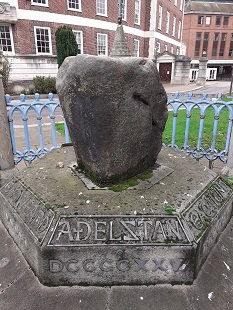
The Saxon Coronation Stone

When I walked along the Link almost a year ago, I missed Kingston’s most historic monument, the Coronation Stone on which Saxon kings Athelstan and Ethelred were allegedly crowned.  It sat just inside the grounds of the Guildhall within its own rather worn metal and concrete enclosure just after the start of the walk.  For such a relic of Anglo-Saxon England, the stone deserves better.  I think there are plans to move it to Kingston’s central marketplace but, as I write, it is still imprisoned at the Guildhall. 

Two primary schools backed on to the route in central Kingston.  Both were bounded by “V mesh fences”, rigid welded wire mesh fencing.  The first was green – like many similar fences I’ve seen across mainland Europe – the second blue.  The other side of the blue fence was a playground of artificial turf.  The day I walked past, children were determinedly running around the perimeter of their playground encouraged by a teacher with a whistle.  I think we had metal fences around the schools 50 years’ ago but not as high or as robust.  I suppose the V mesh fencing is safer for today’s children and real grass might be more difficult to maintain.   

A mile away from central Kingston, the route passed by the borough’s household recycling centre, where we deliver our bulk waste, and feel better about ourselves.  The centre is adjacent to the “Hogsmill Clean Water Depot”, the local sewage works.  You can see the extent of the site from the main railway line, which is elevated here.  From the path, there was little to see except four large vats which gave off a loud humming.  I didn’t smell anything, but at other times you can catch a strong whiff of sewage in the vicinity, a reminder of what we all produce in the comfort of “water closets”. 

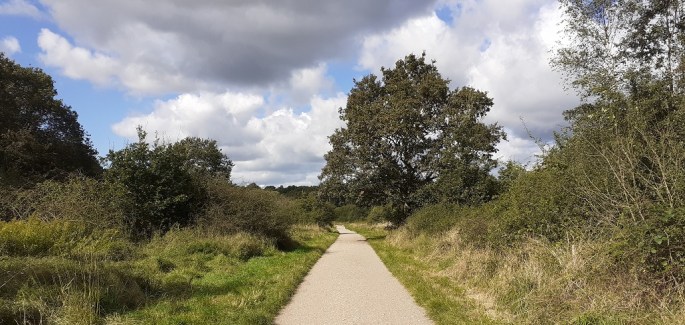
Walking upstream, the Hogsmill was no longer concreted, although it was still in a straightened channel.  The margins gradually widened with reeds, bushes and trees either side.  But before the green passageway opened out, there was a major barrier to negotiate – the A3 trunk road:  a road of escape for us residents of South-West London, to take day trips in the Surrey, Sussex or Hampshire countryside.  

The pathway left the stream and crossed underneath the road via a lit underpass.  The bare concrete walls were clean, bar one graffito.  It said:  “Bitcoin is hope”. 

I was so startled that I didn’t take a photograph, even though I had a camera and a smartphone with me and had resolved to take photos during my walk.  Like the best slogans, it was simple and memorable.  The words dogged my musings for the rest of the walk.  But like other slogans, its brevity and certainty hid so much.  There was no room for doubt about the value of cryptocurrencies, their moral hazard (or lack of), or the relative incomes gained from capital and labour.  Perhaps it had been written by someone desperate to talk up the price of their flutter and who wanted to cash in their gains.  They could have chosen a more prominent place. 

The joys of green spaces
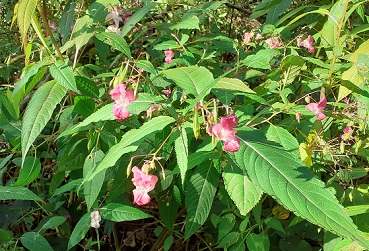
Himalayan Balsam: the downward hanging seed heads ready to explode

On the other side of the A3, the green ribbon of vegetation widened and thickened, and the Hogsmill had space to meander.  I came across lots of Himalayan balsam, a bush that likes boggy ground and whose ripe seed pods explode with light pressure.  It gave me childish delight to squeeze the seed heads.  I know better now.  It is an invasive species whose strong scent is particularly attractive to insects.  It deprives indigenous plants from insect born pollination.  I also saw a flash of a large bird with a brown and white chest, a hooked beak and roundish wings, probably a sparrowhawk and a rare sight in urban areas. 

After crossing a road at traffic lights at the edge of Epsom (“Twinned with Chantilly” the road sign said – another town with a wonderful racecourse), the route left the Hogsmill to cross a series of large open spaces through which the path gradually rose imperceptibly towards the hills beyond.  These spaces are part of the green belt round London.  For all the debates about the need for more housing in Britain, we need to preserve them to temper the worst effects of heat and pollution in built-up areas.  

The green spaces proved to be varied in origin and current use.  In my travels around Europe, I can’t recall such spaces around the largest cities – but I may be wrong.  The first was Tolworth Court Farm,“.. managed for quiet recreation and nature conservation”.  This was an open, rather featureless space (albeit a good place to let a dog run loose).  Next was a thin strip, the Castle Hill Local Nature Reserve some of which was under a line of pylons that were buzzing with electricity.  Benches were set out for walkers to rest and enjoy the greenery and information boards on what wildlife might be seen there.  

After a detour through housing, the Horton Country Park followed.  Here fields were interspaced with dense thickets of bushes and trees.  I saw a roe deer trotting along the edge of one open field, and soon after a field full of llamas grazing from feeders.  Epsom Common was a bit wilder with some parts fenced off to help “restore the natural vegetation”.  I wondered whether “natural” was pre-Roman iron age Britain or pre-industrial revolution.  Ashtead Common had the smartest signs and paths – not surprising given it has been owned by the City of London Corporation since the 1870s.  It is one a string of green spaces around London owned by the Corporation.  I am glad the money men of the City of 150 years ago had such foresight. 
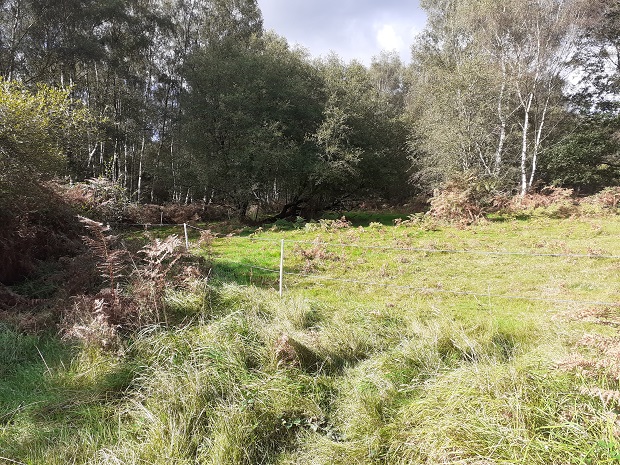
Restoring the natural vegetation on Epsom Common

The last green space was Ashtead Park.  Unlike the others, it was more mixed with large houses scattered amongst green spaces.  Most houses had large cars outside, imposing fences or pristine gardens, or a mix of all.  One of the largest without fence or hedge had a large sign:  “Private Property.  No trespassing.  24 video surveillance”.  Such directness was both jarring and fearful, but maybe the owners had suffered serial burglaries.    

A Roman Road to the chalk hills

The path continued steadily uphill out of Ashtead Park, through Ashtead village and became a slippery track as the path had protruding bits of chalk.  It then turned sharp right.  This was the Stane Street, the ancient Roman road linking London and Chichester. 

True to repute, the route was very straight, and went up and down the chalk slopes with no concession.  I imagine that when the Romans constructed the road, it was a clearway through the ancient forest (or whatever vegetation was on the North Downs in the Iron Age).  Today it is the reverse – the route is now a line of trees with a path running through it, with open land slightly below on either side. 

The first main barrier on this part of Stane Street was a very modern road, the M25, London’s orbital motorway.  The M25 was cut into the chalk hills here and the carriageways curved around the contours.  There was relatively little traffic but enough for the roar of engines to be continuous.  Thankfully, the roar was muffled by the extensive trees and bushes on both sides. 

After about another mile along Stane Street, the path turned off to the right.  The track was no longer built up and I lost sight of the open countryside.  Instead, it was increasingly sunken into the chalk and in some places very slippery.  This was the Mickleham Downs, and as there was little to see except the canopy of trees either side, my mind wondered back to Bitcoin as I plodded on. 
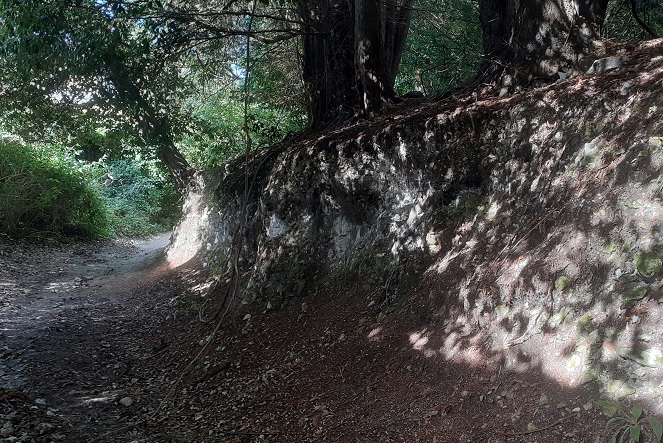
The incised path in the chalk of Mickleham

Eventually, the path descended towards the Mole Valley, one of the main gaps in the North Downs.  It was formed  at the end of the Ice Age as meltwater cut through the chalk.  The end point of the route joined the North Downs Way, a “national trail” which runs east-west along the hills and from which you have great views southwards to the Weald.  I couldn’t find the precise point, but it is near Westhumble where there is a railway station from which I was going to catch a train home.

A group of middle-aged men arrived at the station shortly after me.  They were speaking loudly to one another, and I guess they had had a good lunch out.  One of them walked round the station building looking for something.  He went behind the station building, looked around again and had a quick pee.  He didn’t see me as he found relief – but then I was still in a Bitcoin trance.

The route

The Thames Down Link: there is a written guide of Surrey County Council (archived here) that is a bit out of date – the route on Google maps is slightly different at the start.  The signage along the route is reasonable, but in Kingston don’t always point the right way, and I lost signs at Tolworth Court Farm and near the end around Mickleham.

I walked this in September 2021, so I don’t know if the Bitcoin graffito is still there.
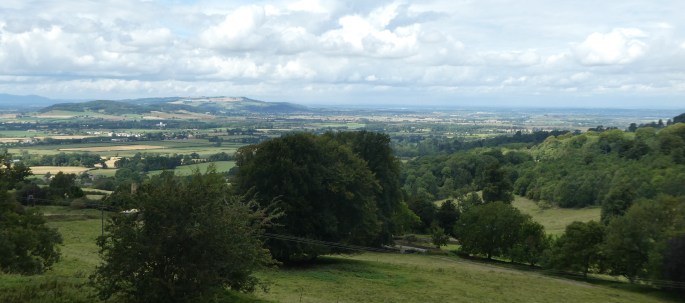
Whither Brexit

Brexit has been the biggest foreign policy issue of the last decade. It is still unfinished business:  the next government will need to take some decisions, above all on the Northern Ireland Protocol.  But there are many other pressing matters to address.  Rather than rush headlong into taking action that the government might quickly regret, here are three aspirations for where we may be going in the next stage of the “Brexit journey”.   

Taking the emotion out of Brexit

One of our neighbours described best the dilemma they faced ahead of the Brexit referendum vote:  their head told them to vote remain, their heart to vote leave.  I have no idea how they voted. 

The leave campaigns were not just about emotion – although “take back control” was an emotional slogan that harked back nostalgically to some earlier golden era.  There was, and is, logic in seeking greater flexibility, accountability and democratic control over the laws and rules under which we are governed.  If only it was simple to roll back nearly 50 years of EU membership.

The leave campaigns could speak optimistically of freedom from the EU and painted Remain as “project fear”.  Others played on the worse nationalist sentiments by talking of ending unbridled immigration, despite the evidence that EU nationals working in the UK contributed more to the national exchequer than they took out. 

Talking about the trade-offs of leaving the European Union was hardly a priority for those making the leave case.  It was easy to downplay the complications of leaving the European Economic Area, Single Market, Customs Union and so on.  The circumstances of the vote and lack of preparation in the event of a leave vote weren’t the fault of leavers.  In opposition, there is little need to be responsible, but once in government that all changes.  You cannot rely on optimism alone.

Cakeism may have had its day.  Those German car companies, French champagne producers and other European businesses didn’t come to the rescue of the British government, as some Leavers claimed would happen, to insist we have full and free access to the Single Market so that they could have full and free access to ours.  But there continues to be a boosterism, despite the lack of evidence of Brexit benefits. 

Making Brexit Safe” has become an article of faith for the Conservative party.  That is not so surprising given that one of the legacies of the Johnson leadership of the party – through the expulsion of Remainer MPs – has been to make it the party of Brexit.  The Conservatives have to make a success of Brexit or, at least, to convince the electorate Brexit has been a success despite the many other challenges.  The policy making priorities should not be dominated by making Brexit safe but keeping Britain safe.

The emotion is on both sides.  Since I left the Foreign, Commonwealth and Development Office, I have been able to give vent to some of my emotion on social media about some of the lines – the money that might go to our beloved NHS above all – and the disingenuity of certain leaders that we could have our cake and eat it.  I have found other former colleagues similarly incandescent that our nations have been led astray by siren voices that we would be better off outside the European Union.  Their rage has reassured me that I am not alone, but anger doesn’t change anything.  On social media, anger tends to lead to heated words rather than reasoned or informed debate.   

Brexit remains an emotive word in other nations of our United Kingdom.  The Scots, who voted most decisively of all the nations, appear to be readier as a nation to leave the Union.  The Northern Irish also voted – just – to remain.  Their anger over the Protocol appears to be following communal divisions and their distrust of the Conservative leadership has been sharpened with the likes of the 2019 election slogan of having “an oven ready deal”. 

We may look back and see Brexit as another example of a populist cause inflamed by the rise of digital and social media and the fragmentation of traditional broadcast and print media.  Most of us realise that we now live in a world of isolated echo chambers.  We tend to read what we want to confirm our existing prejudices. 

We should all hope that emotions cool, that we have a more rational debate about Brexit, its costs, benefits and consequences – ideally distinguished from the effects of the pandemic and the energy crisis.  I suppose I wish for greater pragmatism or, in digital terms, that we spend less time following narratives and more looking at the data. 

Brexit and economic insecurity

One could argue that the major challenges facing us have been made worse by Brexit.  Many may have voted Leave so that we could have full control over our borders and control immigration.  The slogan about how much money we would save from the leaving the EU camouflaged the wider point about how much our largest employer, the NHS, relied on EU, and other foreign, workers.  The points based immigration system may be alleviating labour market shortages, but it is an administrative system and cannot replicate the free movement of workers within the Single Market. 

Making sense of what people voted for has been one of the miseries of the Brexit process.  I recall a conversation with a trade colleague in early 2018 about where we would end up – what EU structures we might stay associated with.  They were confident we wouldn’t leave the Customs Union – British business would insist on that.  However, remaining in the Customs Union would have limited our ability to have trade deals with third countries. 

Leaving the Customs Union has meant that British based companies are no longer able to send goods with minimal let and hindrance to Zagreb, Helsinki, Oslo or Lisbon and many other points in between.  No amount of free trade deals will allow us to have such access for our goods as we have enjoyed within the Single Market.  Exporting cheese to Japan or apples to India is physically more complicated, more expensive and less environmentally sustainable than sending them across the Channel – let alone completing all the custom procedures.  As we saw in March last year, movement of goods internationally was paralysed when a massive container ship blocked the Suez Canal for six days.

The trading opportunities that some Leavers claimed Britain could take advantage of outside the EU in 2016 are not so obvious now.  Our close allies the United States, under the Trump administration (if not so much now), didn’t believe in an open trading system and were especially hostile to Chinese economic hegemony – a country that is a particularly important source of manufactured goods for the UK.  Putin’s war on Ukraine have highlighted the security threat to shipping and international energy supplies. 

It may be that some of our businesses will flourish outside the Single Market and the Customs Union, and that new jobs will be created in service industries to replace jobs lost in manufacturing.  There will remain the dilemma of deciding whether to allow companies that produce, for example, steel to go bust and instead rely on imported steel.  Or how far we should reduce agricultural subsidies and similarly rely on imported food. 

The two candidates for leader of the Conservative party seem intent on scrapping lots of EU regulations to liberate and allow UK businesses to take advantage of the non-EU opportunities.  The problem is that a lot of the regulations exist for a good purpose – to protect consumers and the environment on such as water purity.  Those already exporting to Europe, the US and elsewhere, comply with their domestic regulations.  Having our own different regulations would add a burden to business. 

Exercising greater control or sovereignty may be appealing.  But there are limits to how much we can determine by ourselves.  We need to cooperate and collaborate with our neighbours on the flows of goods, services, capital and people and if we are to guarantee security of supply for all that we import.  I hope that the new government will think hard and carefully before it starts burning regulations and distances us further from the EU. 

Global Britain and the limits of Brexit  

Brexit was unplanned and undefined at the outset.  That lack of definition has dogged the process of untangling ourselves from the EU and its institutions.  The Northern Ireland Protocol remains the main issue to be resolved.  Sadly, but perhaps not unsurprisingly, Northern Ireland seems to be divided internally along sectarian lines on what the British government should do about the Protocol.  

However, the appetite for taking back control has widened beyond leaving the EU.  Some in the Conservative party now want us to leave the European Convention on Human Rights over the interventions of the European Court in British cases on deporting criminals, asylum seekers and other issues.  The Convention was agreed in 1950 in response to the dreadful acts committed before and during the Second World War, and the Court set up in 1959 to enforce the Convention amongst member states. 

Nearly every other European state has signed up to the Convention.  The ECHR is one of the main instruments to protect human rights in our continent.  It would place Britain on a par with Russia – which left this year over its invasion of Ukraine;  and Belarus, which has never been a member unlike some other of the successor states of the Former Soviet Union (for example, Ukraine, Georgia, Armenia and Azerbaijan).  Other member states are more relaxed about Court decisions and not all accept Court decisions as binding. 

Such disruption to the international order would probably outweigh the benefits gained from leaving the Convention.  It would undermine our efforts globally to improve adherence to human rights and put us at odds with our major security allies in NATO, especially now with the Russian war on Ukraine.  It would give succour to nationalists in other countries who might be tempted to copy Putin. 

In our interconnected world, our internal debates about Brexit, our future relationship with our European neighbours and our place in the world, are widely read (if not understood).  While it is largely an advantage having English as the international language of exchange, and such leading media as the BBC and the Economist as major sources of news and comment, it also means foreigners tend to know much more about our internal politics than we do about theirs.  The domestic rhetoric about Brexit hasn’t resonated well in other countries. 

Some of the Brexit rhetoric has been dissonant with the public lines around promoting Global Britain, the new role for Britain that people like me were promoting post-Brexit.  Global Britain itself has felt more of a slogan than a policy or strategy.  However, if we are to benefit from Brexit and embrace the trade deals and the advantages from being outside the EU, we need to be more receptive to our future partners’ interests and requests.  Proposing to tear up or withdraw from international agreements, which runs so counter to our traditions and reputation for reliability, is not a reassuring sign for countries with whom we want trade deals. 

If we are to make a success of Brexit – however that may be defined – we need to attract and not deter.  Displaying a bit of humility and realism – in private if not necessarily in public – might go down well with our friends and allies who, like us, believe in democracy and the rule of law. 

I hope that whoever leads the country in the coming weeks is candid about the trade-offs that we face from Brexit and stays more closely aligned with our European neighbours and allies.  Is that too much to ask?